



By Kirsten Korosec, TechCrunch
Tesla published a form on Thursday for businesses interested in buying Cybercab fleets or providing infrastructure for its network, the latest sign that the company’s aspirations for its gold-hued autonomous vehicle stretch beyond being a robotaxi operator.
The robotaxi interest form, which was released ahead of the company’s Cybercab event in Austin, is not definitive proof that Tesla will sell its autonomous vehicles to third-party operators. But it’s certainly an indicator of where the company’s longer-term plans lie. Tesla wants to scale and it doesn’t seem to want to do it alone.
Tesla CEO Elon Musk has talked often, and for years, about building a massive fleet of low-cost robotaxis. But in the early days, those dreams centered on personally owned Tesla vehicles. As early as 2016, Musk spoke publicly about a future in which Tesla owners, equipped with self-driving software, would be able to earn money by renting out their vehicles. He stuck with that Tesla network idea for years, noting at the company’s Autonomy Day in 2019 that it would allow owners to add their autonomous vehicles to its ride-sharing app, similar to how Uber’s business model works.
“I feel very confident predicting that there will be autonomous robotaxis from Tesla next year — not in all jurisdictions because we won’t have regulatory approval everywhere,” Musk said in 2020.
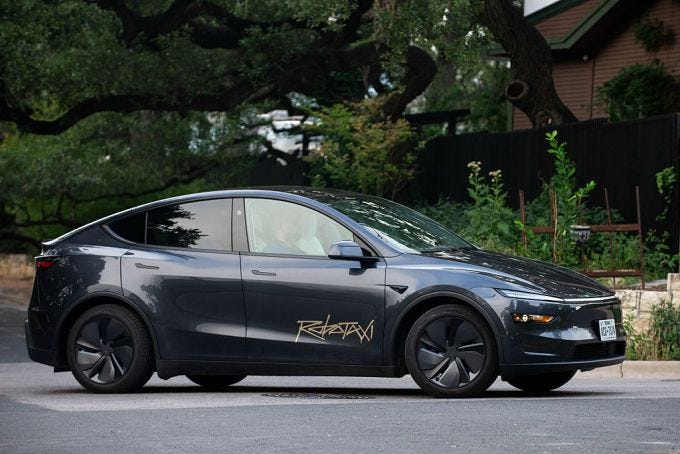
That vision never materialized. Instead, the company has focused on testing, and now operating, its own fleet of robotaxis — first with Tesla Model Y vehicles and now the purpose-built Cybercab.
Until now, Tesla seemed committed to keeping its robotaxi business in-house. The interest form, which says “helps us build our robotaxi network,” suggests the company sees promise and profits in widening the circle to include third-party companies.
What that might look like, though, isn’t defined. The company asks interested parties to pick one of several possible options, including Cybercab fleet purchasing, mobility hubs and infrastructure, event collaboration, and “other.”
There are a growing number of companies jumping into the robotaxi fleet management business. For instance, Moove, an African fintech startup that initially focused vehicle financing for ride-hailing drivers, is scaling up an autonomous fleet management business. The startup, which raised $250 million last month at a $2.1 billion valuation, is the fleet operator for Waymo in Phoenix, Miami, and Las Vegas, and in the future, London. The company doesn’t own the Waymo vehicles, but its CEO told TechCrunch that it plans to.
Other autonomous fleet management companies, which Uber has partnered with in its bid to own a piece of the robotaxi market, include Avomo and New Horizon as well as larger more traditional rental car giants like Avis and Hertz.
Tesla’s welcome mat to fleet operators could encourage more small players to open up shop — helping the company saturate markets faster.
The Cybercab is Tesla’s ‘fork in the road’ moment

Today could be the day Tesla changes forever.
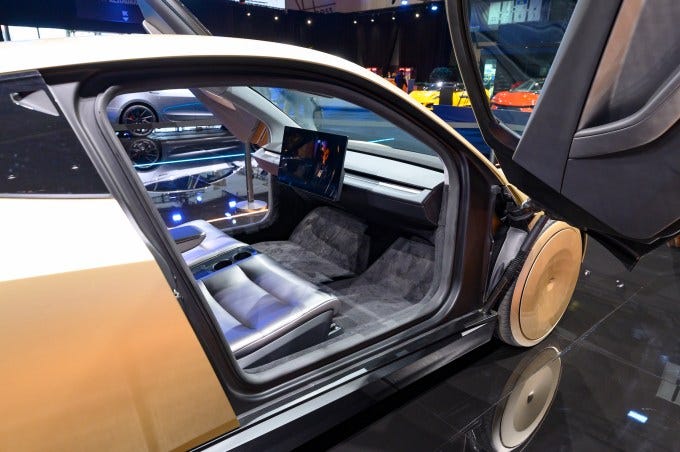
In a couple of hours, Tesla will “launch” the Cybercab — a small, gold, two-seater sedan with no steering wheel or pedals that uses cameras and AI to navigate the world — in its hometown of Austin, Texas.
The company hasn’t said what the launch will entail, exactly. It could be a few cars offering rides in a small area downtown, or a far grander affair in both size and scope.
Tesla certainly wants you to believe it’s the latter.
In the runup to the event, Tesla staged dozens — perhaps more — of its Cybercabs around Austin and in many other U.S. cities. At the time this story was published, 420 autonomous vehicles were registered in Texas, according to the state’s automated vehicle tracker.
Ashok Elluswamy, the head of Tesla AI, recently said in a post on X that the “streets won’t be the same anymore.” When another user wrote that Tesla is “about to flood Austin,” CEO Elon Musk replied: “Yes.” On Wednesday night, Musk posted a seemingly AI-generated photo of the Cybercab consuming the city alongside a massive dust storm.
“A Storm of Cybercabs,” Musk wrote in another post.
These gravitas-laced posts mark a departure from the company’s go-slow-and-safe messaging in the months leading up to the event. Musk and other Tesla executives had previously professed they were taking a cautious approach to its robotaxis in the name of safety, though at times they seemed more concerned about public perception of a potential failure.
Of course, Tesla’s launch strategy isn’t as meaningful as the outcome. Tesla’s ability to successfully build a robotaxi network around the Cybercab would provide the first tangible evidence that it has transitioned from an automaker with some side projects to an AI and robotics company.
There’s a trope Musk favors that is apt for this moment: the fork in the road. It was the subject of an email he sent to Twitter employees in 2022 when he gave them an ultimatum to stay or leave. He invoked it again in early 2025 when he encouraged federal government employees to leave as part of his job leading DOGE, before he truly started wrecking house.
Musk loves the metaphor so much that he commissioned a 30-foot-tall sculpture of a literal fork on a literal road for Burning Man in 2022, before moving the sculpture to a Tesla office.
The Cybercab is Tesla’s fork in the road. This is either the moment the company begins to transform urban transportation as we know it, or the moment that reveals that, despite its many efforts, Tesla really is just an automaker after all.
Robot taxis
Musk first revealed the Cybercab in 2024 at a Hollywood movie lot. But the idea has been around far longer.
Musk has spent more than a decade promising that Tesla would find a way to make its cars fully autonomous, paving the way for a network of robotaxis. He even went so far as to claim, in 2016, that every Tesla being made had the capability to become fully autonomous and that the cars only needed the right software update to make it happen.
He was wrong. Tesla has reworked the hardware in its cars multiple times since that declaration, and Musk recently admitted that millions of them will need some kind of hardware retrofit to become autonomous.
Still, Tesla kept developing driving automation software. It has steadily released and refined its primary offering, Full Self-Driving (Supervised). But as capable as that software has become, it is still driver-assistance software. The responsibility and liability remain with the driver.
The Cybercab is supposed to change all that. It emerged from an effort by Tesla to develop a next-generation EV platform that was cheaper to build.
The plan was for the company to take what it learned from the Model 3 and Model Y — its two biggest mass-market successes — and develop a new platform that would cost half as much, allowing Tesla to make more affordable EVs.
Years of reporting and Musk’s own biography have shown that he was so dead set on achieving full autonomy that he decided against building a manually drivable car on the platform. Instead, Musk focused entirely on using the new platform to power the two-seater robotaxi we now know as the Cybercab.
In April 2024, months ahead of the Cybercab reveal, he approved massive layoffs at Tesla in service of going “balls to the wall for autonomy,” which he called a “blindingly obvious move.”
“Everything else is like variations on a horse carriage,” he wrote at the time.
Slowly, then quickly?
Tesla started testing the first version of its Robotaxi program last June in Austin using modified Model Y SUVs. For the first few months, the company had an employee in the front seat (sometimes behind the wheel, sometimes in the passenger seat) who could stop the car if something went wrong.
Things have gone wrong along the way, though not catastrophically. Tesla has reported a few dozen incidents in Austin since it launched the Robotaxi pilot. Most were minor crashes with stationary objects, and a few involved teleoperators remotely moving the vehicles at low speeds.
The company has expanded this Model Y-based system to a few other cities in Texas and Florida. But over the past year, the network has not lived up to the hype Tesla manufactured at launch in June 2025. In July, the company revealed that the number of paid miles the network was facilitating was actually moving backward.
But that may not matter much to Tesla, which believes scaling its robotaxi network requires the Cybercab.
Tesla designed the Cybercab around cost. It’s smaller, lighter, and has a lower-capacity battery pack than any other Tesla. Fewer raw materials — especially on the battery side — make it cheaper to build. The cheaper it is to build, the faster Tesla can potentially turn a profit once it’s deployed.
That math has Tesla’s most ardent fans giddy. They look at Tesla’s ability to build dozens of Cybercabs for roughly the same amount of money Waymo spends to purchase and outfit fewer than 10 of its newest “Ojai” vans and see it as proof that the robotaxi war is already won.
Musk seems to agree. In a reply to a post that included a graphical representation of this argument, he wrote, “this doesn’t even take into account the operational efficiency of Cybercab.”
There are caveats worth considering. Tesla has, to date, only operated its robotaxi network within a geofence in each city. While some are larger than others, and the company has kept expanding some of them, Musk himself once said: “If you need a geofenced area, you don’t have real self-driving.”
Then there’s the challenge of operating the network at scale.
Tesla has so far benefited from having a small network in just a few cities. That naturally means its self-driving software encounters fewer edge cases than Waymo, which has 4,000 robotaxis on the road. Fewer trips and fewer edge cases also mean fewer chances for riders to spot problems and post them on social media or report them to regulators or journalists.
Tesla has also benefited from the fact that its fleet has consisted of Model Y SUVs, which are harder to distinguish on the road than a bright white Jaguar I-Pace kitted out with sensors. That will change with the Cybercabs. If Tesla’s software isn’t up to the task, its failures will be much harder to miss when they happen in shiny gold cars.
The Best “Go Paid” Deal on Substack! You Get REAL Stuff!!

Go paid at the $5 a month level, and we will send you both the PDF and e-Pub versions of Etienne’s new book: To See the Cage Is to Leave It - 25 Techniques the Few Use to Control the Many and a coupon code for 10% off anything in the https://artofliberty.org/store/.
Go paid at the $50 a year level, and we will send you a free paperback edition of Etienne’s new book: To See the Cage Is to Leave It - 25 Techniques the Few Use to Control the Many OR “Government” - The Biggest Scam in History… Exposed! OR a 64GB Liberator flash drive if you live in the US. If you are international, we will give you a $10 credit towards shipping if you agree to pay the remainder.
Support us at the $250 Founding Member Level and get a signed high-resolution hardcover of “Government” - The Biggest Scam in History... Exposed! + Liberator flash drive + a signed high-resolution hardcover of Etienne’s new book: To See the Cage Is to Leave It - 25 Techniques the Few Use to Control the Many + everything else in our “Everything Bundle” of the best in voluntaryist thought delivered domestically. International pays shipping. Our only option for signed copies besides catching Etienne at an event.